News,

From June 16 to 18, 2026, the second edition of the “GPR Supporting Archaeology” training course took place in Chiusi (Siena, Italy). The course was dedicated to the application of Ground Penetrating Radar (GPR) technologies in archaeological investigations.
The initiative, coordinated by Lorenzo Lambiase of Novatest, was organized through a collaboration between the Archaeological Superintendency, the Regional Directorate of Museums of Tuscany, the CADMO Centre of the University for Foreigners of Siena, and the Municipality of Chiusi, with the support of the National Etruscan Museum of Chiusi.
The training program combined classroom sessions with practical field activities, giving participants the opportunity to learn GPR survey methodologies and data interpretation techniques directly within some of Chiusi’s most significant archaeological sites.
Field exercises were carried out in Piazza del Duomo and the Poggio Renzo Necropolis, allowing participants to experience firsthand the value of non-invasive geophysical investigations in historically important environments.
Today, Ground Penetrating Radar (GPR) is one of the most effective non-invasive techniques for investigating the subsurface without excavation.
Its ability to detect buried structures, walls, cavities and other underground anomalies makes it an essential tool for archaeologists, supporting excavation planning while contributing to the preservation of cultural heritage.
The Chiusi project clearly demonstrates how geophysical technologies can successfully complement archaeological research, providing valuable information through innovative and non-destructive investigation methods.
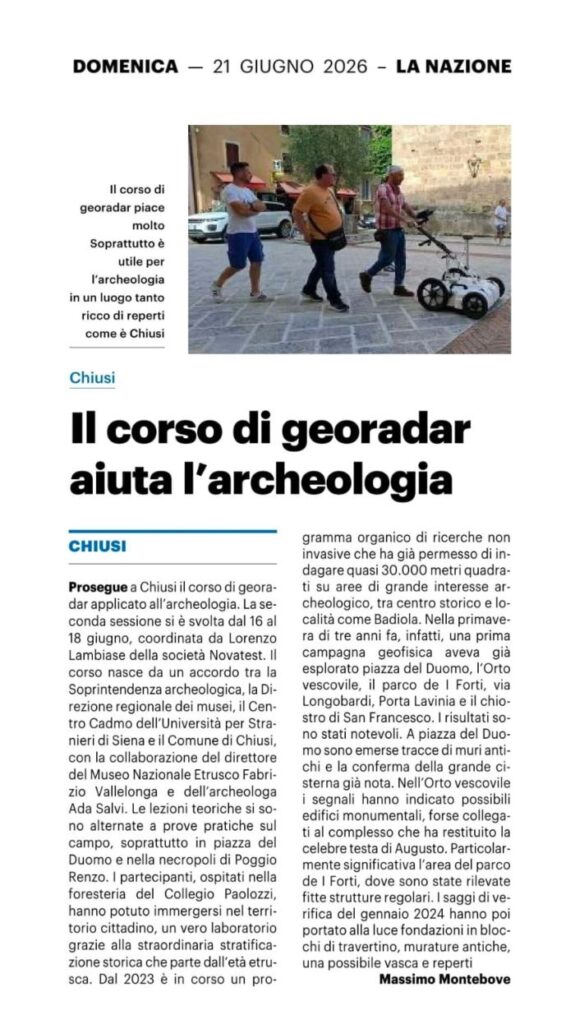
Since 2023, the city of Chiusi has been involved in an extensive program of non-invasive geophysical investigations covering approximately 30,000 square meters of archaeologically significant areas.
The surveys carried out over the past few years have revealed important archaeological evidence throughout the historic center and surrounding areas, further confirming the effectiveness of GPR technologies in supporting archaeological research and heritage conservation.
Through initiatives such as “GPR Supporting Archaeology”, Novatest continues to promote the dissemination of advanced expertise in Ground Penetrating Radar technologies, combining theoretical knowledge, practical experience and hands-on field applications.
Collaboration with research institutions, public authorities and industry professionals remains a key element in advancing innovative methodologies that support archaeological investigation and the protection of cultural heritage.
Content created with the assistance of AI


Fill out the form with your details specifying what you need in the request type section. Our team is at your disposal to find the best solution to you needs.

Novatest srl
Via Albertini, 36/F8
Gross Ancona
60131 Ancona (AN) - IT