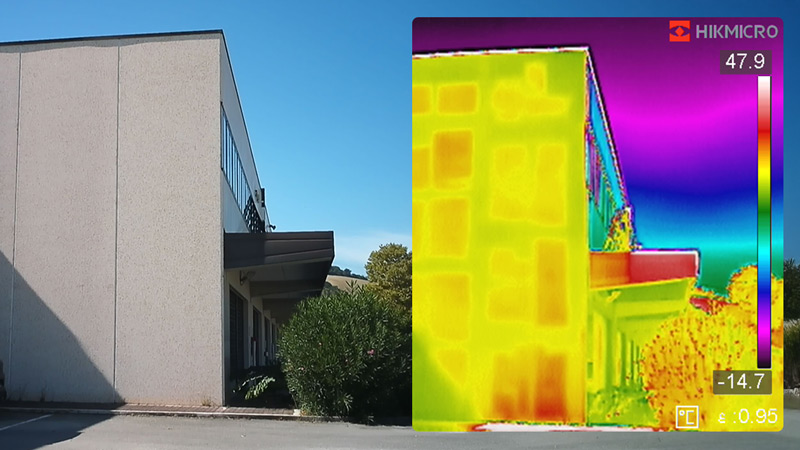
Method Thermography (TT)
Browse the calendar to find out when the next one is scheduled.
In accordance with UNI 11931 “Certification of technical personnel involved in non-destructive testing in the field of civil engineering and cultural and architectural heritage”.

Ancona, online and in-person modes

3 and 5 March and from 10 to 11 March 2026

11 March 2026
The course covers the study of testing methods, applications and case study analysis, practical exercises, and the processing and presentation of results for the drafting of test reports.
The programme is structured as follows:
Practical exercise section:
Level 2 Certification Exams:
| Topic | |
| 1. | Theoretical part |
| 1.1 | Purpose and scope of application |
| 1.2 | Regulatory references |
| 1.3 | Principle of the test method |
| 1.4 | Heat transfer: heat, temperature, energy, principles of thermodynamics, phases of matter (solid, liquid, gas), temperature scales, Fourier’s law, Newton’s law, Planck’s law, Wien’s law, Stefan-Boltzmann law, thermal properties of materials, steady-state and transient regimes, thermal diffusivity |
| 1.5 | Infrared theory: electromagnetic spectrum, emissivity, reflection, transmission, absorption, evaporation, black/grey body, Kirchhoff’s law, emissivity of materials, temperature measurement with or without contact |
| 1.6 | Applications: energy dispersion, thermal bridges, detection of structural elements, adhesion defects, discontinuities, detachments, cracks, water infiltration, rising damp, condensation, mold, civil system inspection |
| 1.7 | Limitations of the test method |
| 1.8 | Equipment: classification of thermal cameras, parameters and measurement methods for characterizing thermal cameras, complementary accessories for performing the test |
| 1.9 | Criteria for selecting thermal input: contact heat load, radiation heating, flash lamp heating, step heating with halogen lamps, other thermal loading devices |
| 1.10 | Information on the object to be analyzed: characteristics, surface condition, construction technology, types of detectable defects |
| 1.11 | Test conditions: measurement of environmental parameters, reflected radiation, emissivity |
| 1.12 | Qualitative procedure with active or passive excitation, comparative procedure with active or passive excitation, quantitative procedure with active or passive excitation |
| 1.13 | Test area |
| 1.14 | Procedure: camera operation check, focus adjustment, correction for atmospheric absorption and reflected radiation, emissivity setting, evaluation of spatial emission, measurement of incidence angle, selection of temperature range and level, sampling frequency setting, data recording |
| 1.15 | Expression of results |
| 1.16 | Factors influencing the test |
| 2. | Practical part |
| 2.1 | Practical exercise |
| 2.2 | Result reporting |
| 2.3 | Test report drafting |
| 2.4 | Drafting instructions for Level 1 personnel |
To be admitted to the method certification examinations, candidates must:


Fill out the form below with your information, and we will contact you as soon as possible.

Novatest srl
Via Albertini, 36/F8
Gross Ancona
60131 Ancona (AN) - IT


