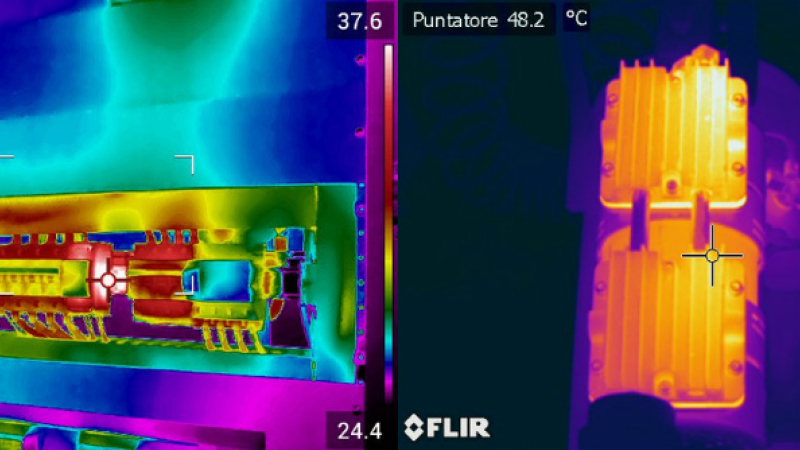
Metodo Infrared Thermography (TT)
The UNI EN ISO 9712 standard, “Non-destructive testing – Qualification and certification of personnel involved in non-destructive testing,’ regulates certification in methods used in non-destructive testing in the industrial sector. Personnel qualification is concrete proof of operators” technical skills and a guarantee for manufacturers or service companies that perform the tests.
The course is divided into five days covering the study of methodology in a multi-sector context, including civil (B), industrial (I) and electrical (E) fields. The course is aimed at preparing students for the RINA Level 2 Certification exam in accordance with ISO 9712.
The thermographic method (TT) is a suitable investigation for identifying external, sub-surface and internal discontinuities that manifest themselves as differences in the surface temperature of the object under examination. Thermography is a completely non-destructive inspection method that is very useful for checking structures, materials, industrial and electrical systems. It is a method that is usually effective in combination with other non-destructive tests in the field of civil engineering: from visual inspection to ground-penetrating radar, load testing and many other situations where a preliminary investigation is required to study the characteristics of a structure.
| PRODUCT SECTOR | FIELD OF APPLICATION |
| Civil (B) | – thermal bridge surveys – definition of hidden building structures – surveys of plaster and/or tile detachment and similar – water leak and infiltration detection – checking the tightness of fixtures and fittings – detection of capillary rising damp – surface condensation – preservation of artistic heritage – energy dispersion in building envelopes – checking the efficiency of heating and plumbing systems for residential use |
| Industrial (I) | – plant engineering – pressure equipment – heat exchangers – preventive maintenance – process analysis – gas leak detection – checking for operating irregularities due to inadequate lubrication (friction between moving mechanical parts) – misalignment – component wear – manufactured and semi-finished metal products |
| Electrical (E) | – checking for overloads on electrical components installed inside electrical panels – stators of electrical machines – transformer components – electrical cables distribution lines – insulators – connection terminal blocks – checking the efficiency of photovoltaic panel cells |


Fill out the form below with your information, and we will contact you as soon as possible.

Novatest srl
Via Albertini, 36/F8
Gross Ancona
60131 Ancona (AN) - IT


