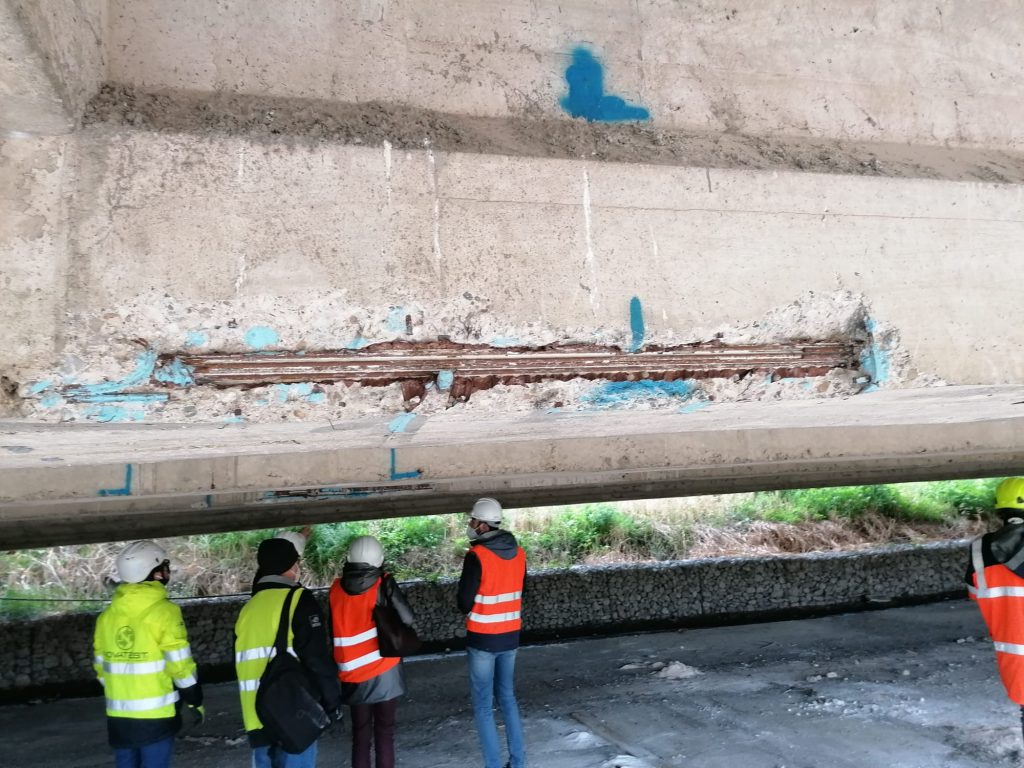
Method VISUAL TESTING (VT)
Browse the calendar to find out when the next one is scheduled.
In accordance with UNI 11931 ‘Certification of technical personnel involved in non-destructive testing in the field of civil engineering and cultural and architectural heritage’

Rome, online and in-person modes

12, 13, 24, 25, 26 February 2026

26 February 2026
The course includes the study of methodology, case study analysis, practical exercises with subsequent data processing in preparation for the RINA Level 2 examination.
Course programme:
12 February Online
13 February Online
24 February In person (Rome)
25 February In person (Rome)
26 February In person (Rome)
26 February, afternoon Certification exam in person (Rome).
| Topic | |
| 1.1 | Theoretical part – structures in ordinary and prestressed reinforced concrete |
| 1.1.1 | Purpose and scope of application |
| 1.1.2 | Regulatory references |
| 1.1.3 | Overview of defects: lack of plumb, incorrect installation, non-standardized compaction and curing processes, abrasion wear, surfacing of air bubbles on the extrados, formwork stripping defects, cracks, microcracks, widespread crazing, slab deformation, surface delamination, dust generation, segregation, honeycombing, scaling due to alkali–aggregate reaction, scaling due to freeze–thaw cycles, permeability, spalling of concrete cover |
| 1.1.4 | Overview of degradation due to physical causes (environmental conditions and effects of atmospheric pollution, acid rain and freeze–thaw cycles of water within the pores of the cementitious matrix), chemical causes (carbonation, chloride attack, sulfate attack) and mechanical causes (loads, stresses, impacts, fires) |
| 1.1.5 | Equipment: inspection hammer, plumb line, spirit level, tape measure, measuring wheel, laser distance meter, vernier caliper, binoculars, portable optical micrometer, magnifying lenses, rigid or flexible endoscope, camera, etc. |
| 1.1.6 | Procedure |
| 1.1.7 | Identification and localization of defects and degradation: lack of plumb, passive moisture stains, active moisture stains, washed-out/deteriorated concrete, presence of crawl spaces, spalling of concrete cover, oxidized and/or corroded reinforcement, map cracking, capillary cracks, horizontal and longitudinal cracks, vertical cracks, diagonal or transverse cracks, cracks at stirrups, cracks at beam–column joints, cracks at beam–slab connections, cracks near anchorages, deteriorated construction joints, crushing cracks, exposed/oxidized stirrups, broken stirrups, deformed longitudinal reinforcement, web cracks along prestressing cables, cracks along the bulb flange, exposed and degraded ducts, exposed and oxidized wires, exposed and oxidized strands, reduction of prestressing reinforcement, presence of moisture in ducts, etc. |
| 1.1.8 | Expression of results |
| 1.1.9 | Preparation of the visual inspection report |
| 1.2 | Theoretical part – steel structures |
| 1.2.1 | Purpose and scope of application |
| 1.2.2 | Regulatory references |
| 1.2.3 | Overview of defects: lack of plumb, incorrect installation |
| 1.2.4 | Overview of degradation due to physical causes (environmental conditions and effects of atmospheric pollution, acid rain), chemical causes (oxidation and corrosion) and mechanical causes (loads, stresses, impacts, fires) |
| 1.2.5 | Equipment: inspection hammer, plumb line, spirit level, tape measure, measuring wheel, laser distance meter, vernier caliper, binoculars, portable optical micrometer, magnifying lenses, rigid or flexible endoscope, camera, etc. |
| 1.2.6 | Procedure |
| 1.2.7 | Identification and localization of defects and degradation: paint flaking, riveting defects, loose bolts, sheared bolts/rivets, web/flange deformation, deformation of box girder walls, joint damage, corrosion, oxidation, surface defects of base material, etc. |
| 1.2.8 | Expression of results |
| 1.2.9 | Preparation of the visual inspection report |
| 1.3 | Theoretical part – masonry structures |
| 1.3.1 | Purpose and scope of application |
| 1.3.2 | Regulatory references |
| 1.3.3 | Overview of defects: lack of plumb, incorrect installation, cracks, microcracks, incompatibility of materials used in maintenance and/or restoration |
| 1.3.4 | Overview of degradation due to physical causes (environmental conditions and effects of atmospheric pollution, acid rain and freeze–thaw cycles of water within the pores of the mortar matrix, rising damp), chemical causes (chloride attack, sulfate attack, nitrate attack), biological causes (molds, fungi, algae, lichens, bacterial colonies, presence of vegetation) and mechanical causes (loads, stresses, impacts, fires, erosion due to mechanical action of wind and driving rain) |
| 1.3.5 | Equipment: inspection hammer, plumb line, spirit level, tape measure, measuring wheel, laser distance meter, vernier caliper, binoculars, portable optical micrometer, magnifying lenses, rigid or flexible endoscope, camera, etc. |
| 1.3.6 | Procedure |
| 1.3.7 | Identification and localization of defects and degradation: lack of plumb, horizontal cracks, vertical cracks, diagonal cracks, missing masonry portion, transverse cracks, longitudinal cracks, deteriorated construction joints, moisture/rising damp stains, washout, dark-colored stains, efflorescence, biological patina, pulverization of mortar or stone elements, exfoliation, etc. |
| 1.3.8 | Expression of results |
| 1.3.9 | Preparation of the visual inspection report |
| 1.4 | Theoretical part – timber structures |
| 1.4.1 | Purpose and scope of application |
| 1.4.2 | Regulatory references |
| 1.4.3 | Overview of visually inspectable characteristics of wood that reduce strength |
| 1.4.4 | Overview of degradation due to physical causes (environmental conditions, humidity variations, exposure to high temperatures), biotic causes (molds, fungi, bacteria, insects, marine organisms) and mechanical causes (loads, stresses, impacts, erosion due to mechanical action of wind) |
| 1.4.5 | Equipment: inspection hammer, plumb line, spirit level, tape measure, measuring wheel, laser distance meter, vernier caliper, binoculars, portable optical micrometer, magnifying lenses, rigid or flexible endoscope, camera, etc. |
| 1.4.6 | Procedure |
| 1.4.7 | Identification and localization of defects and degradation through analysis of visually inspectable characteristics |
| 1.4.8 | Expression of results |
| 1.4.9 | Preparation of the visual inspection report |
| 2. | Practical part |
| 2.1 | Practical exercise |
| 2.2 | Presentation of results |
| 2.3 | Preparation of the test report |
| 2.4 | Preparation of instructions for Level 1 personnel |
To be admitted to the method certification examinations, candidates must:
Once your enrolment in the course has been confirmed, please send the following documentation to formazione@novatest.it:


Fill out the form below with your information, and we will contact you as soon as possible.

Novatest srl
Via Albertini, 36/F8
Gross Ancona
60131 Ancona (AN) - IT


